
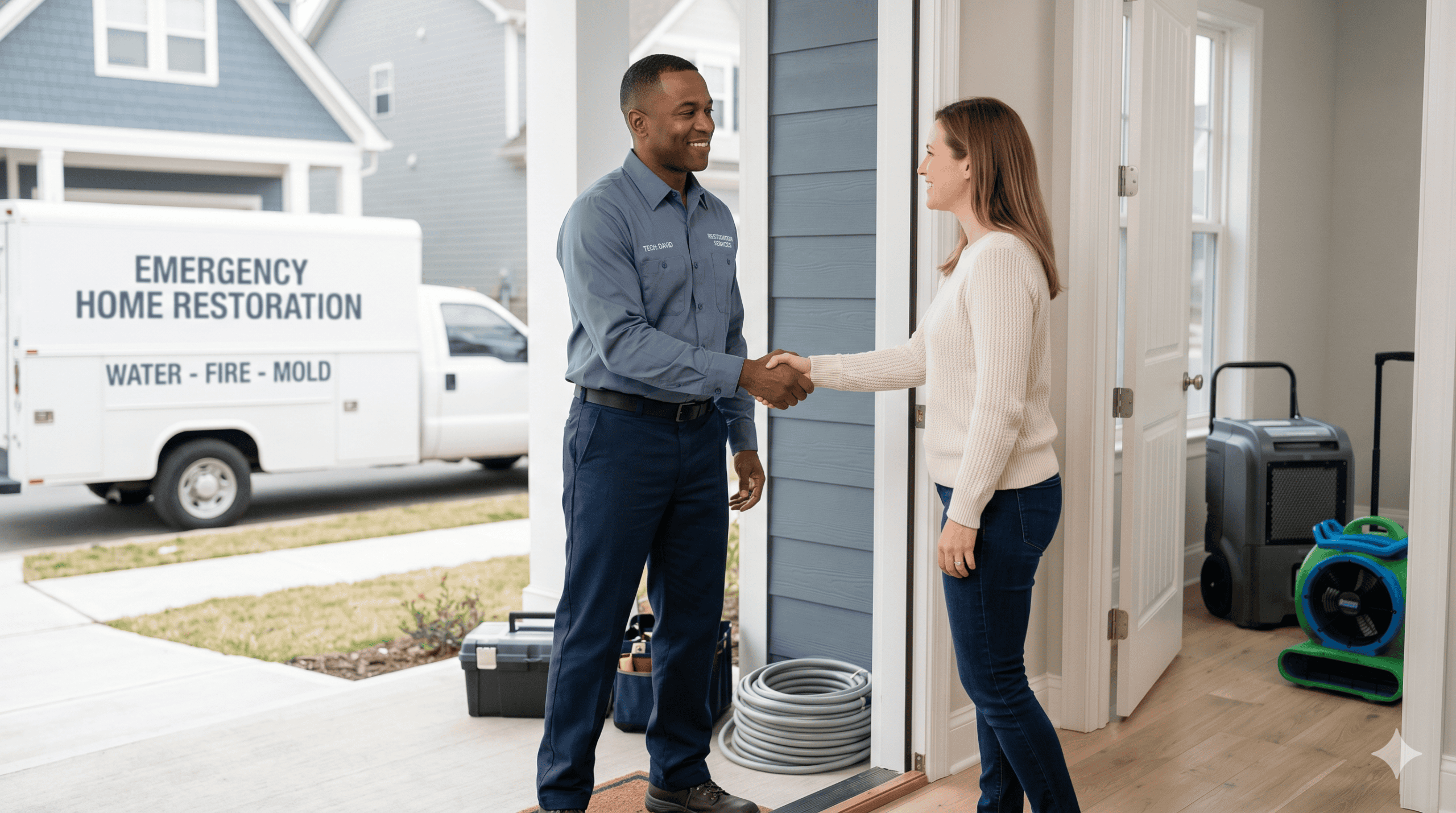
Knowing how to choose a water damage restoration company is one of the hardest calls a homeowner makes — because you are making it under pressure, with water actively spreading through your home, in a situation you have probably never encountered before.
Predatory contractors know this. Storm chasers, unlicensed operators, and companies with no intention of providing proper documentation exist in every market. The homeowner who signs before checking credentials, or who agrees to work without a written scope, frequently ends up with an incomplete job and a failed insurance claim.
This guide gives you the exact verification steps and questions to ask before any restoration contractor begins work on your property.
Key Takeaways
- Verify credentials before anyone touches your property — ask for the contractor’s license, a certificate of insurance, and check business standing with your state and the Better Business Bureau.
- Walk away from clear red flags: no written scope of work, pressure to sign immediately, full payment demanded upfront, no documentation during the job, or unusually low bids.
- Ask five questions up front, including whether they provide daily moisture readings and a drying log, and whether they bill your insurer directly.
- Referral networks are a legitimate way to reach pre-screened, available contractors quickly — but the same verification steps still apply.
- Understand what you’re signing before agreeing to an assignment of benefits, which transfers your right to collect insurance payment to the contractor.
Step One: Verify Credentials Before Anyone Touches Your Property
Contractor’s license
Restoration work — including water extraction, structural drying, and mold remediation — requires a contractor’s license in most US states. The licensing requirement varies by state, but a legitimate operation will have no hesitation providing their license number for verification. Look up the license on your state’s contractor licensing board website before work begins. An unlicensed contractor performing work on your home creates liability issues for you as the property owner.
Liability insurance and workers’ compensation
Request a certificate of insurance, not just verbal confirmation. The certificate should show general liability coverage and workers’ compensation. If a worker is injured on your property and the contractor lacks workers’ compensation insurance, the liability can fall to you as the homeowner. Any legitimate restoration company provides this documentation immediately and without resistance.
Business standing
Search the company name in your state’s Secretary of State business registry. A company that cannot be found, or that was registered two weeks ago, warrants significant skepticism — particularly following a major storm or weather event that attracts transient contractors.
Check the company’s standing with the Better Business Bureau
Red Flags: Walk Away From These
No written scope of work before starting
A legitimate restoration professional assesses the damage, explains the scope, provides a written plan of action, and gets your signature before equipment is deployed. Any contractor who wants to begin immediately without a written scope is creating a situation where the final invoice is unverifiable.
Pressure to sign immediately
Emergency situations create urgency — legitimate contractors understand this without weaponizing it. A company that insists you sign right now or lose the crew is using tactics designed to prevent you from doing basic verification. Real restoration professionals will secure the property and give you a reasonable window to review documentation.
Payment demanded entirely upfront
Standard practice in professional restoration is a deposit or insurance assignment, with the balance due at completion. Contractors requiring full cash payment before work begins, or who insist on cash-only arrangements, are operating outside normal industry practice.
No documentation provided during the job
Professional restoration generates documentation throughout: baseline moisture readings, daily moisture and humidity logs, equipment placement records, and a final clearance report. If a contractor completes a job and provides no written documentation, your insurance claim has no evidentiary foundation. This is not a documentation style preference — it is the technical basis of a legitimate claim.
Unusually low bids
Water damage restoration is equipment-intensive and labor-intensive. A bid significantly below market rate either means the scope of work has been missed, corners will be cut, or the contractor has no intention of providing professional-grade service. Get at least two scopes of work before comparing prices.
Five Questions to Ask Before Agreeing to Any Work
Can I see your contractor’s license and certificate of insurance right now?
A legitimate professional produces these immediately. Hesitation, redirection, or promises to provide them later are disqualifying responses.
Will you provide a written scope of work with itemized line items before starting?
The scope of work is the contract between you and the restoration company. It should describe every action to be taken, why it is necessary, and the industry basis for each decision. Verbal scopes are unenforceable.
Do you provide daily moisture readings and a daily moisture log throughout the job?
This is the documentation your insurance adjuster needs to verify that drying was completed properly. A company that does not provide this either lacks the equipment to generate it or does not perform professional-grade work.
Do you work directly with homeowners’ insurance companies?
Most professional restoration companies bill insurers directly with your authorization. This simplifies the claim process significantly. Companies that insist on homeowner payment and reimbursement create additional friction and risk.
What is the estimated timeline and how will you communicate progress?
A professional should be able to give you a realistic timeline based on the initial moisture assessment, explain how daily monitoring works, and commit to a communication cadence throughout the project.
(To read more about Insurance claims, see: How to Document Insurance Claims)
About Referral Networks
Referral networks — services that connect homeowners with local restoration professionals — are a legitimate and increasingly common way to access verified contractors quickly in an emergency. A good referral network has pre-screened its contractors for licensing and insurance, routes calls to crews with the right equipment for the specific type of damage, and handles the matching so you are not calling seven companies at midnight trying to find someone available.
Regardless of how you find a contractor — direct search, referral network, or insurance company recommendation — the same verification steps apply. Ask for the license. Ask for the insurance certificate. Get the scope of work in writing. These steps take five minutes and protect you against the most common restoration fraud scenarios.
Frequently Asked Questions
Does my insurance company choose the restoration contractor?
Your insurer may recommend preferred vendors, but in most states you have the right to choose your own contractor. Using an insurer’s preferred vendor can simplify billing, but it is not required. Verify independently before agreeing to any referral from your insurer if you have reason to question the contractor’s credentials.
What if a contractor starts work before I can verify credentials?
Stop the work politely but immediately. You have the right to verify credentials before any work proceeds on your property. A legitimate contractor will not object.
Can I get a second opinion on the scope of work?
Yes, and for large-scope events you should. A second assessment costs nothing and gives you a basis for comparing scope and approach. Significant variation between two scopes warrants asking each contractor to explain the difference.
What is an assignment of benefits and should I sign one?
An assignment of benefits (AOB) transfers your right to collect insurance payment directly to the contractor. In some states — particularly Florida — AOB agreements have been subject to significant fraud and regulatory scrutiny. Understand what you are signing before agreeing to an AOB, and ask your insurer directly whether they recommend or have restrictions on AOB agreements in your state.