
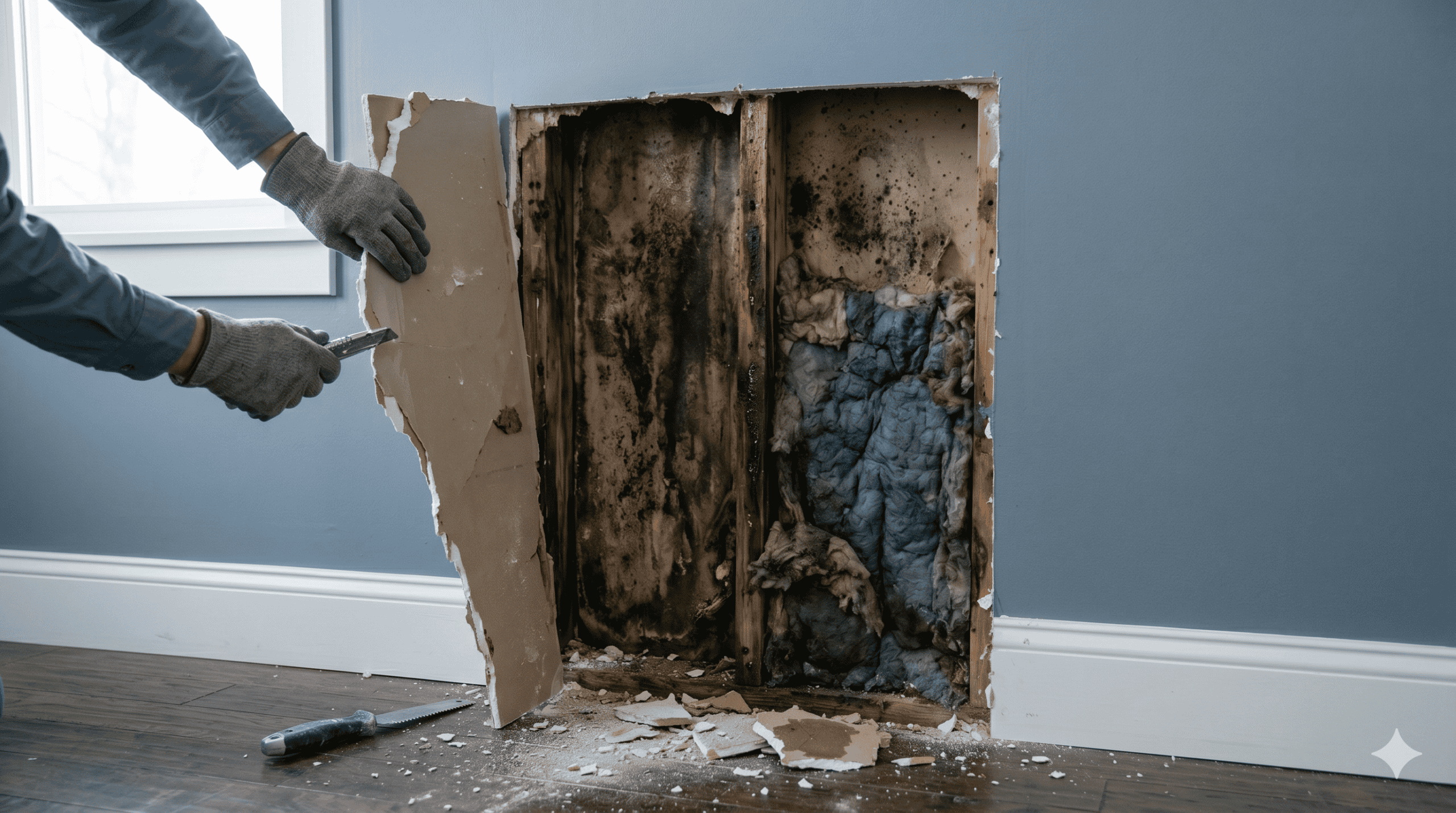
Water damage does not stop when the source stops. The pipe is patched, the valve is shut, the appliance is disconnected — and the damage continues spreading into your walls, subfloor, and structural framing for hours and days afterward. The cost of delaying water damage restoration is real: Every hour between the event and professional treatment is an hour that determines whether your restoration costs $2,000 or $20,000.
Speed is the one variable in water damage recovery that is entirely within a homeowner’s control.
Key Takeaways
- Water damage doesn’t stop when the source is shut off — it keeps spreading into walls, subfloor, and framing for hours and days afterward.
- Time is the one recovery variable fully within your control; everything else is fixed by the time you discover the event.
- Treated within two hours, an event often dries fully in place for $1,500–$4,000; treated at 48 hours, the same event can run $6,000–$15,000 with mold risk added.
- A 2-hour versus 48-hour response on the same event can mean $10,000–$20,000 in additional restoration and reconstruction cost.
- Common reasons for delay — letting it “dry on its own,” waiting on insurance, or DIY over a weekend — all tend to increase damage, since most policies actually require prompt mitigation.
The Real Cost of Delaying Water Damage Restoration, Hour by Hour
Within the first hour
Water from a supply line or pipe failure is initially Category 1 — clean water with minimal contamination risk. At this stage, porous materials are beginning to absorb. Drywall wicks moisture upward from its base. Subfloor panels begin to swell at their edges. Carpet is saturated but padding may still be salvageable. A restoration crew arriving within this window has the highest probability of drying everything in place with no material removal required.
Hours 2 through 24
Water continues traveling. Capillary action pulls moisture horizontally through wall cavities and vertically through building materials in ways that are not visible on the surface. What appeared to be a contained bathroom floor event has wicked into the adjacent bedroom wall. Drywall that absorbed moisture begins to lose structural integrity. Category 1 water in contact with building materials begins transitioning toward Category 2 as microbial activity begins. Carpet padding in a warm environment is now almost certainly a removal item rather than a dry-in-place item.
The 24 to 48 hour window
This is the critical threshold. Dormant mold spores — present in virtually every building environment — require sustained moisture and organic material to germinate. At 24 to 48 hours of saturation in humid conditions, those requirements are met inside wall cavities, under flooring, and within insulation. The project has not yet crossed into active mold territory, but it is approaching it. A restoration crew arriving at 36 hours is still ahead of visible mold growth but facing significantly more material removal than a crew arriving at 4 hours.
Beyond 48 hours
Active mold growth begins. What was a water extraction and structural drying project is now a water extraction, structural drying, and mold remediation project — three scopes of work instead of one, each with its own cost, timeline, and documentation requirements. Category 1 water that was left untreated has long since degraded to Category 2 contamination levels in affected materials. Structural wood with elevated moisture content begins to support fungal growth that can spread to areas well beyond the original water footprint.
(To read more about the different water categories, see: Water Categories 1, 2 & 3 explained)
(To read more about the risk of mold growth, see: Mold after Water Damage)
The Financial Cost of Each Delay Window
These are not hypothetical numbers — they reflect the difference in scope that restoration professionals document across events treated at different points in the damage timeline.
Treated within 2 hours: Full drying in place likely. No drywall removal. Carpet may be salvageable. Subfloor typically saved. Total restoration cost range: $1,500 – $4,000.
Treated at 12 to 24 hours: Wall cavity moisture requires targeted drywall cuts or full removal in affected sections. Carpet padding almost certainly removed. Subfloor may require drying in place with specialty equipment. Total restoration cost range: $3,500 – $8,000.
Treated at 48 hours: Substantial drywall removal likely. All carpet and padding removed. Active mold risk assessment required. Mold remediation scope begins if present. Total restoration cost range: $6,000 – $15,000.
Treated after 72 hours or beyond: Full drywall removal in affected zones. Mold remediation required. Structural assessment for any framing affected by prolonged moisture. Possible HVAC inspection if moisture reached ductwork. Total restoration cost range: $12,000 – $30,000+.
The difference between a 2-hour response and a 48-hour response — on the same original event — can easily be $10,000 to $20,000 in additional restoration and reconstruction cost.
Why Homeowners Delay — And the True Cost of Each Reason
“I’ll let it dry out on its own.”
Building envelopes are designed to retain heat and moisture, not release it. Without mechanical dehumidification, moisture trapped inside wall cavities and under flooring does not dry — it redistributes into other materials and creates sustained high-humidity conditions that accelerate mold development. Surface drying creates a false impression that the underlying structure is also dry. It almost never is.
“I’m waiting to see if insurance covers it.”
Most homeowners insurance policies for sudden and accidental water events require prompt mitigation as a condition of coverage. Waiting for coverage confirmation before beginning extraction is specifically the situation that gives insurers grounds to reduce or deny claims on the basis that additional damage resulted from failure to mitigate. Call your insurer while the restoration crew is working — not instead of calling the restoration crew.
“I’ll handle it myself over the weekend.”
Household fans and shop vacuums remove surface water and improve airflow. They do not extract moisture from inside building materials, they cannot reduce humidity to drying thresholds inside wall cavities, and they cannot generate the moisture and humidity records your insurer requires to confirm proper drying. DIY attempts often delay professional treatment by 24 to 48 hours — the most expensive delay window in the timeline above.
The One Variable You Control
Every other factor in water damage recovery — the scope of initial damage, which materials were affected, local humidity conditions, the category of water — is fixed by the time you discover the event. The time between discovery and professional treatment is the one factor you can change.
The cost of a restoration crew arriving in two hours versus 24 hours is identical. The scope of work they face — and the invoice at the end — is not.
Frequently Asked Questions
Does delayed water damage affect my insurance claim?
Yes, in two ways. First, most policies require prompt mitigation — significant delays give insurers grounds to attribute additional damage to negligence rather than the original event. Second, the larger the scope of damage, the more complex and contested the claim becomes. A clean, well-documented early-response claim is significantly easier to process than a large delayed-response claim with mold remediation added.
What if I discover the damage days after it happened?
Call a restoration professional immediately regardless of when you discovered the event. Document the discovery thoroughly — photographs, video, written notes with the date and time you found the damage. The restoration crew’s initial assessment will document the scope, and that documentation becomes the basis of your claim. Discovery date and event date are different things, and insurers understand this.
Is a slow leak as urgent as a sudden burst?
Slow leaks discovered early are often less severe than sudden pipe failures, but they carry a particular risk: gradual leaks are commonly excluded from homeowners insurance as maintenance neglect. A slow leak discovered and treated immediately has the best chance of coverage approval; a slow leak left untreated for months typically does not. Treat any discovered leak as urgent regardless of flow rate.