
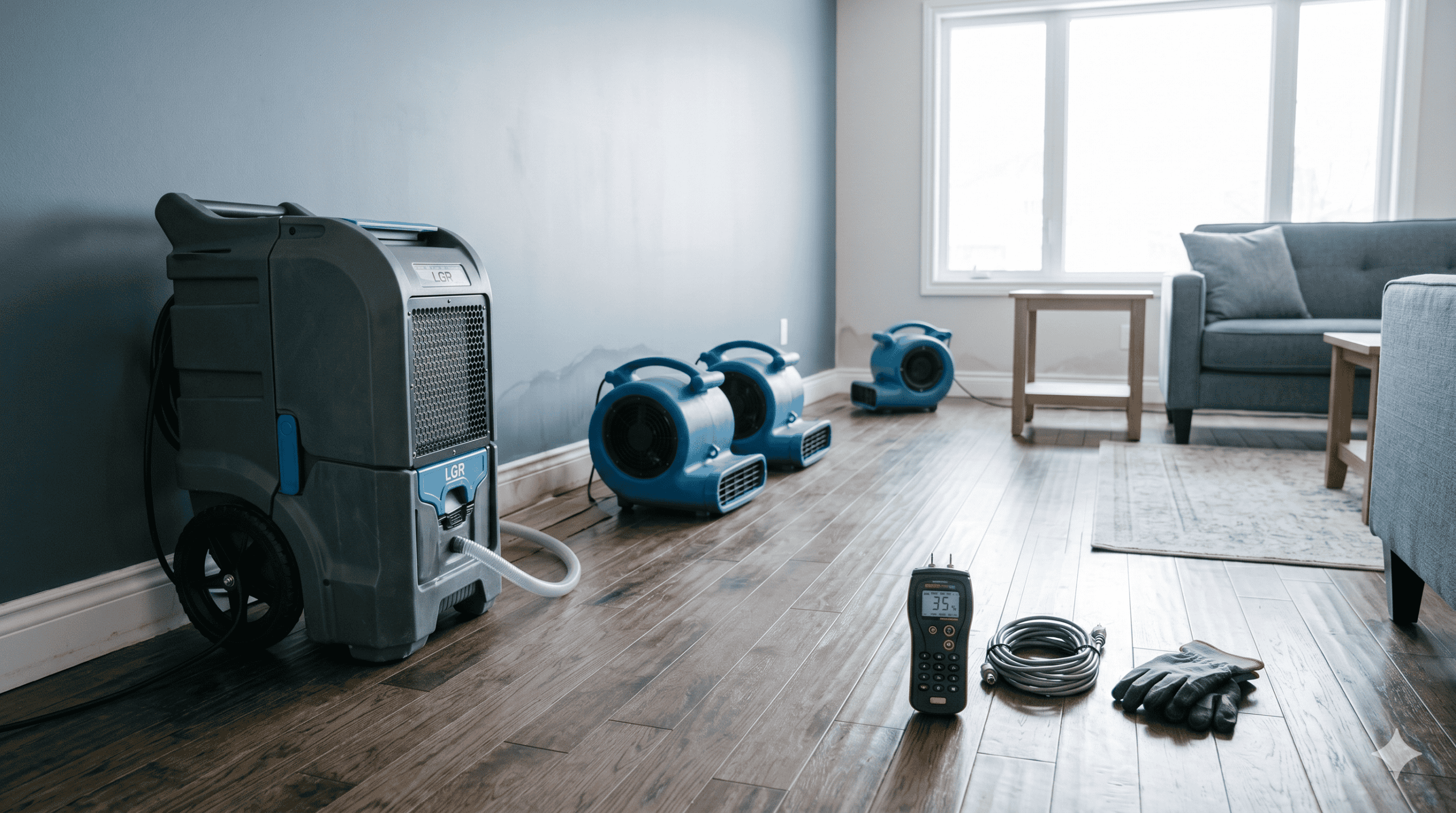
How long water damage drying takes depends on more than the calendar — professional structural drying typically runs three to five days, but that range can compress to two days for a small clean-water event treated immediately or extend past two weeks for a severe or delayed-treatment situation.
What determines the timeline is not the calendar — it’s the specific conditions of your property, your materials, and when treatment began.
Key Takeaways
- Professional structural drying typically takes three to five days, but can be as short as two days for a small clean-water event or extend past two weeks for severe or delayed cases.
- The timeline depends on the water category, how deeply the water penetrated, how long it sat before treatment, the materials involved, and your local humidity.
- Drying is complete when moisture readings confirm materials have reached normal levels — not when surfaces feel dry to the touch.
- Dense materials like hardwood and concrete dry far more slowly than carpet or drywall and can add days to the cycle.
- Removing drying equipment early is a costly mistake — trapped moisture can trigger mold within 48 hours, turning a few more days of drying into a separate remediation project.
How Long Water Damage Drying Takes: The Three-to-Five-Day Standard
Under normal conditions — a Category 1 clean water event affecting carpet and drywall in one or two rooms, treated within a few hours of occurring — professional drying crews expect to achieve full structural drying in three to five days. This assumes industrial-grade dehumidifiers running continuously, air movers deployed in the correct configuration, and daily moisture and humidity monitoring to track progress.
“Three to five days” is not a guess or a sales pitch. It is the drying window validated by daily moisture readings. Restoration professionals use penetrative moisture meters and thermal imaging to measure moisture content inside walls, floors, and ceilings throughout the cycle. The job is not complete when the surface feels dry. It is complete when all materials test within established normal moisture content thresholds — typically 10 to 15 percent for structural wood and 0.5 to 1.5 percent for concrete and masonry.
What Actually Determines Your Timeline
Water category
Category 1 clean water dries fastest — no decontamination required, most materials can be dried in place. Category 2 gray water adds sanitization protocols and often requires removal of carpet padding, extending the timeline by one to two days. Category 3 black water from sewage or external flooding requires full removal of all porous materials in the affected zone before drying can begin — this adds days to the project scope before the drying clock even starts.
Water class
Separate from category, the class describes how deeply water has penetrated building materials. Class 1 events affecting a small area with minimal absorption can sometimes dry in two days. Class 3 events — where water entered from above and saturated walls, insulation, and ceiling assemblies — regularly take five to seven days even with proper equipment. Class 4 situations involving hardwood floors, concrete, or plaster require specialty low-humidity drying equipment and can run seven to fourteen days.
How long water was present before treatment began
This is the single factor with the most control over cost and timeline. Water treated within two hours of the event frequently dries in place with minimal material removal. The same event left untreated for 24 hours may require wall cavity drying that adds two to three days. Left 48 hours or longer, conditions become favorable for mold germination — and once active mold is present, the project shifts from drying to remediation, a separate scope that adds additional days and significant cost.
The materials involved
Dense hardwood flooring holds moisture and releases it slowly — it can extend a drying cycle by three to five days compared to carpet. Plaster walls in older homes absorb and retain moisture differently than modern drywall, often requiring longer drying windows and different equipment configurations. Concrete dries far more slowly than drywall. When a restoration crew assesses your property, the materials present directly shape the projected timeline.
Local climate conditions
Industrial drying equipment operates against your ambient environment. A property in a high-humidity climate — a coastal city, a summer event in the Southeast — requires dehumidifiers to work harder and longer to achieve the same moisture reduction as the same job in a lower-humidity region. Restoration professionals set drying targets based on local humidity conditions, not a universal standard. Your local climate is a real variable in the drying timeline.
What Professional Drying Actually Looks Like Day by Day
Day 1: Initial assessment and setup. Moisture mapping using thermal imaging and penetrative meters establishes baseline readings in every affected material. Extraction equipment removes standing water. Dehumidifiers and air movers are deployed in a configuration specific to your floor plan and affected materials.
Days 2–3: Daily moisture readings track progress. The crew adjusts equipment placement if moisture is moving unevenly — tracking into areas not initially identified. The relative humidity in the affected space should be dropping measurably each day.
Days 3–5: Continued monitoring. As materials approach target moisture levels, equipment may be scaled back. The crew documents readings throughout to build the moisture and humidity log your insurance adjuster needs.
Final day: All materials test within normal moisture content thresholds. A formal drying clearance report is issued documenting that structural drying is complete. This report is the document your insurer uses to close the restoration phase of your claim.
(For more cleanup guidance, see professional drying practice)
Why Rushing Drying Always Costs More
The pressure to get equipment out of your home sooner is understandable — the machines are loud, they run constantly, and they seem excessive after the visible water is gone. Pulling equipment before the drying cycle is complete is one of the most expensive decisions a homeowner makes during water damage recovery.
Incomplete drying leaves residual moisture trapped inside wall cavities, under flooring, and inside insulation — invisible to the naked eye and undetectable without a moisture meter. That moisture does not evaporate on its own in a sealed building envelope. Within 48 hours of equipment removal, it creates the sustained high-humidity conditions that support mold germination. What would have been completed with a few more days of dehumidification becomes a mold remediation project that costs thousands more and takes another week or two to resolve.
A legitimate restoration crew will not recommend removing equipment before moisture readings confirm drying is complete. If a contractor suggests cutting the drying cycle short for any reason other than confirmed clearance readings, treat that as a red flag.
Frequently Asked Questions
Can I stay in my home during water damage drying?
In most cases, yes — industrial drying equipment is loud but not dangerous, and the affected rooms remain accessible. For Category 3 black water events requiring full decontamination, some or all of the home may need to be vacated during the remediation phase. Your restoration crew will advise based on the specific contamination involved.
Do I need to run the equipment myself overnight?
No. The equipment runs continuously and unattended. Turning it off overnight — even for one night — significantly extends the drying timeline because building humidity rises during the off period and must be reduced again when equipment restarts. The crew will advise on access for daily monitoring visits.
How do I know the drying is actually complete?
Your restoration crew should provide daily moisture readings and a final clearance report showing all materials have reached target moisture content levels. Do not accept verbal confirmation of completion — the written clearance report with documented readings is what your insurer needs and what protects you from future claims about incomplete drying.
What happens if drying is incomplete and mold develops later?
If mold develops after restoration due to incomplete drying, it is typically treated as a separate loss event by insurers — meaning a new claim, potentially a new deductible, and possible coverage complications. This is the core reason clearance documentation matters.