
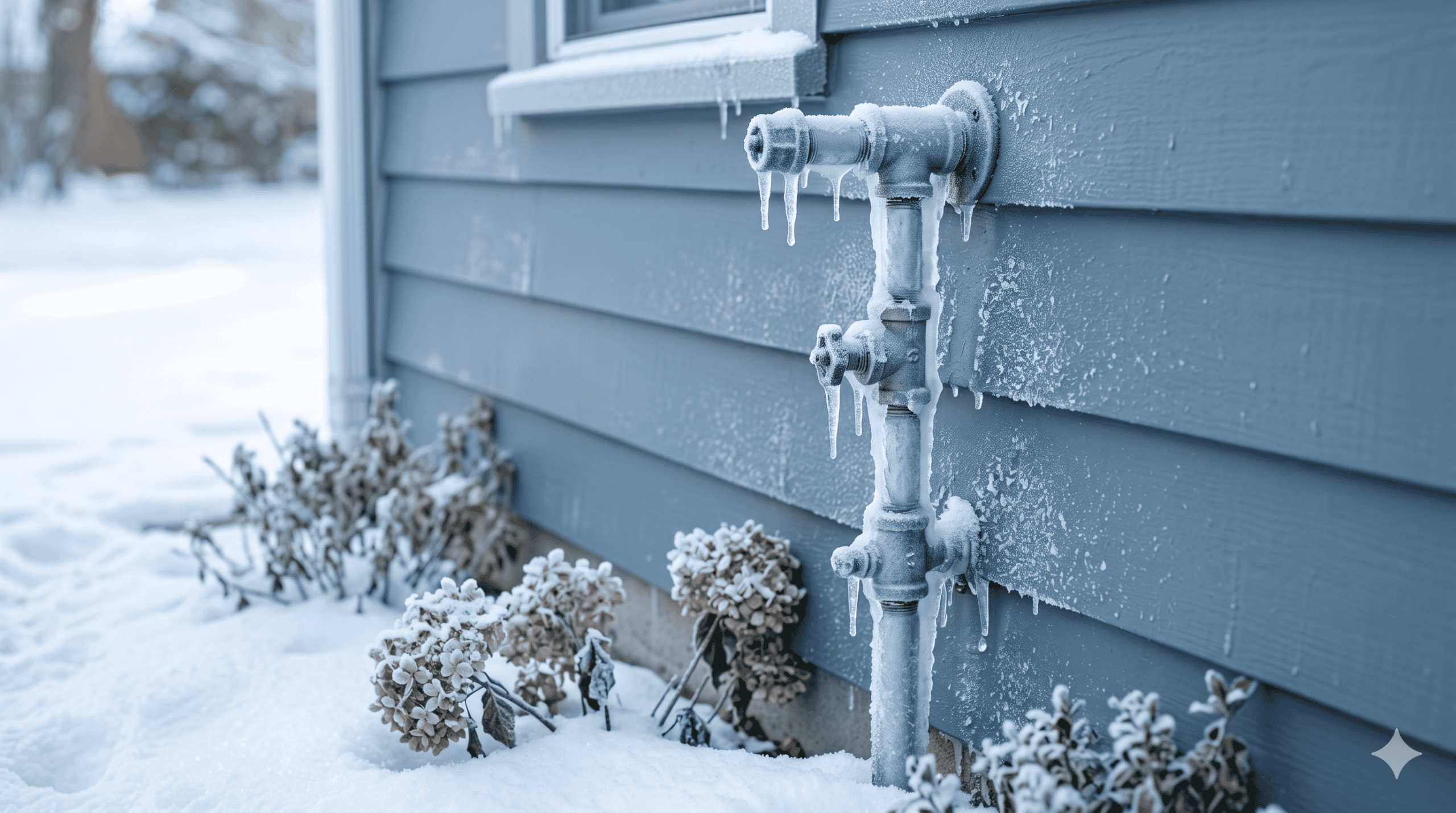
Burst Pipes in Winter is a common phenomenon but not all US cities face the same risk in winter. The combination of local climate, housing stock age, pipe infrastructure, and — critically — whether local homes were built to handle cold at all, creates dramatically different risk profiles across the country.
Some cities with brutal winters have relatively lower burst pipe rates because their homes were built for the cold, with pipes routed through interior walls and properly insulated. Others with milder climates have outsized burst pipe rates because their infrastructure was never designed to handle sustained freezing temperatures.
Understanding the real risk drivers explains why some of the most damaging freeze events happen in cities that are not known for cold weather.
Key Takeaways
- Not all cold cities face equal risk — burst pipe probability depends on climate, housing age and pipe material, and whether local homes were built to handle freezing at all.
- Rapid temperature swings cause more failures than steady cold, which is why severe burst-pipe events often strike milder-climate cities unprepared for a sudden hard freeze.
- Older housing stock with cast iron or galvanized steel plumbing carries elevated risk regardless of climate, while newer homes with PEX have materially lower risk.
- Southern and high-elevation cities can see low-frequency but high-severity events, as the 2021 Texas winter storm demonstrated.
- Before winter: locate your main shutoff, insulate exposed pipes, keep interiors above 55°F, and know what era of plumbing your home has.
The Three Risk Factors That Determine Burst Pipe Probability
Factor 1: Annual freeze days and January low temperatures
The raw number of days at or below 32°F matters, but it is not the whole picture. What determines pipe failure most directly is the combination of sustained cold and rapid temperature swings. Pipes that are consistently cold all winter adapt — the water inside remains liquid because it is continuously moving and the pressure is consistent.
What causes catastrophic failure is rapid temperature change: a warm spell that allows pressure to normalize inside the pipe, followed by a sudden hard freeze that catches homeowners unprepared and pipe insulation inadequate. This is why single-event freeze disasters often occur in cities with moderate climates — they are not prepared for the cold that arrives suddenly.
Factor 2: Housing stock age and pipe material
The construction era of a home’s plumbing largely determines its freeze vulnerability.
Homes built before 1960 predominantly use cast iron and galvanized steel pipe systems. These materials are strong but have become increasingly brittle after five to seven decades of thermal cycling and internal corrosion. They develop micro-fractures that propagate under freeze pressure.
Homes built between 1960 and 1985 generally use copper supply lines. Copper is more flexible than galvanized steel and handles moderate freeze events better, but develops pinhole leaks in hard-water environments and remains vulnerable to extended hard freezes.
Homes built after 1985 increasingly use CPVC and PEX piping. PEX in particular has significant freeze tolerance — it can expand under ice pressure and often returns to shape without failure. Modern homes with PEX plumbing have materially lower burst pipe risk than older housing stock in the same climate.
Cities with predominantly older housing stock — Rust Belt cities, older Northeastern metros, historic Southern cities — carry elevated burst pipe risk regardless of climate because the infrastructure itself is more vulnerable.
Factor 3: Infrastructure design assumptions
Homes in consistently cold climates are built with freeze prevention assumptions designed in: pipes routed through interior walls, insulated at exterior wall penetrations, and connected to systems designed for sustained cold. Homes in historically mild climates make different assumptions — pipes may run through exterior walls, crawlspaces, and uninsulated spaces because freezing temperatures were historically rare.
When a polar vortex event brings sustained temperatures well below freezing to a city where homes were built without freeze assumptions, the failure rate is dramatically higher than in northern cities with equivalent cold exposure.
High-Risk City Profiles
Established Freeze-Climate Cities: Consistently High Risk
Cities across Michigan, Ohio, Pennsylvania, and the upper Midwest carry elevated burst pipe risk every winter — but their infrastructure is largely calibrated for cold. The risk is real and produces consistent year-over-year claims volume.
Cities like Flint, MI face compounding risk from severe winters — approximately 130 freeze days annually with January lows near 16°F — combined with predominantly 1920s-1960s cast iron and galvanized steel plumbing throughout the residential housing stock. Aging infrastructure plus reliable hard winters equals consistent high claim volume throughout the December-February window.
Similarly, cities like Reading, PA and Davenport, IA combine significant housing stock from the early-to-mid 20th century with reliable Midwest and Mid-Atlantic winter temperatures that stress aging pipe joints repeatedly across each season.
Rust Belt Cities: Infrastructure Age as the Amplifier
What distinguishes Rust Belt cities from other cold-climate metros is the combination of severe winters and unusually high concentrations of pre-1960s housing. When a city like Flint has 70% or more of its housing stock predating 1970, the majority of residential plumbing is cast iron and galvanized steel that has now been in service for 50-70+ years.
The issue is not just age — it is age combined with thermal stress cycling. Every winter freeze-thaw cycle creates micro-stress in aging pipe joints and in the internal corrosion layer that galvanized steel develops over decades. Each cycle slightly increases failure probability. By year 60 or 70, the cumulative damage to a pipe system that has been through 60-70 winters is substantial.
High-Elevation Cities: More Cold Than Their Latitude Suggests
Several US cities at significant elevation experience winter cold that surprises residents who associate their region with mild weather.
Asheville, NC sits at approximately 2,100 feet elevation in the Blue Ridge Mountains — well above the surrounding Piedmont, which experiences mild winters. Asheville’s elevation brings freeze events that are significantly more frequent than a homeowner accustomed to Piedmont NC weather would expect. When families relocate from Charlotte to Asheville without adjusting their winterization practices, they frequently encounter their first burst pipe event.
Similarly, cities at elevation in the Southwest — like Pueblo and Boulder, Colorado — experience hard winter cold despite regional reputations for mild weather. Pipes in these markets are often routed through exterior walls with minimal insulation because freeze events were historically infrequent — a situation that has changed with more extreme winter weather patterns.
Southern Cities: Low Frequency, High Severity
The most damaging individual burst pipe events in terms of total claims volume frequently occur not in cold-climate cities but in cities where winters are normally mild and infrastructure is not designed for sustained cold.
The February 2021 Texas winter storm is the clearest modern example: sustained temperatures well below freezing for multiple days in a state where residential plumbing routinely runs through exterior walls, uninsulated crawlspaces, and attic spaces. Cities like Lubbock, TX, which do experience regular winter cold but whose housing stock reflects a dry, mild-climate construction tradition, were among the hardest hit.
When southern and southwestern cities experience polar vortex events, the combination of unprotected infrastructure and homeowner inexperience with freeze events creates failure rates that exceed what happens in northern cities with equivalent temperature exposure.
What High-Risk Cities Have in Common
Across all categories — established freeze climates, Rust Belt cities, high-elevation cities, and southern cities vulnerable to polar events — the highest-risk properties share several characteristics:
Pipes routed through exterior walls, garages, or uninsulated crawlspaces. Housing built before pipe insulation and routing standards addressed freeze risk. Homes that have not been winterized despite being in a historically cold-season market. Properties that have recently been purchased by new owners unfamiliar with local winter conditions.
What Homeowners in At-Risk Cities Should Do Before Winter
Locate your main water shutoff before freeze season. In a burst pipe event, the speed at which you can stop water flow determines how much damage results. Know where the shutoff is and verify it operates correctly.
Insulate exposed pipes. Pipe insulation foam is inexpensive and takes an afternoon to install on any pipes running through unheated spaces, exterior walls, or garages.
Maintain interior temperature. Keep the home above 55°F even when unoccupied. The cost of heating an empty home is a fraction of the cost of a burst pipe restoration event.
Know what category of housing you own. Pre-1960s homes with original cast iron or galvanized plumbing in freeze-climate cities should be on an accelerated inspection schedule. A plumber who identifies weakening joints before a freeze event costs a fraction of a restoration crew responding after one.
Frequently Asked Questions
What temperature causes pipes to burst?
Pipes are most at risk when sustained temperatures drop below 20°F, particularly when that cold reaches uninsulated areas of the home. However, pipes can fail at temperatures above 20°F if they are poorly insulated, run through drafty exterior walls, or have existing weak points from corrosion or prior damage. The temperature threshold is not fixed — it varies with insulation, pipe material, and exposure duration.
(III covers freezing-pipe prevention and the burst mechanism)
Do newer homes have lower burst pipe risk?
Generally yes. Homes built after the mid-1980s increasingly use PEX supply lines, which have significant flexibility and freeze tolerance compared to older materials. Modern plumbing code also requires better pipe routing and insulation in cold-climate applications. However, no home is immune — outdoor hose bibs, garage plumbing, and pipes in uninsulated additions remain vulnerable in any construction era.
Is burst pipe risk increasing with climate change?
The data suggests that extreme cold events — polar vortex intrusions into historically mild regions — are increasing in frequency and severity, even as average temperatures warm. This means the at-risk population for sudden, catastrophic freeze events is expanding southward and into markets not historically associated with winter pipe failures. The 2021 Texas event is the most visible example of this trend.
How quickly after a freeze event should I check my pipes?
Check pipes during the thaw, not during the freeze. Many burst pipes do not release water until ice melts and pressure returns — meaning the freeze event itself may pass without visible damage, with failure occurring during the warm-up. Inspect supply lines under sinks, at appliance connections, and in any unheated space during the first warm hours after a hard freeze.