
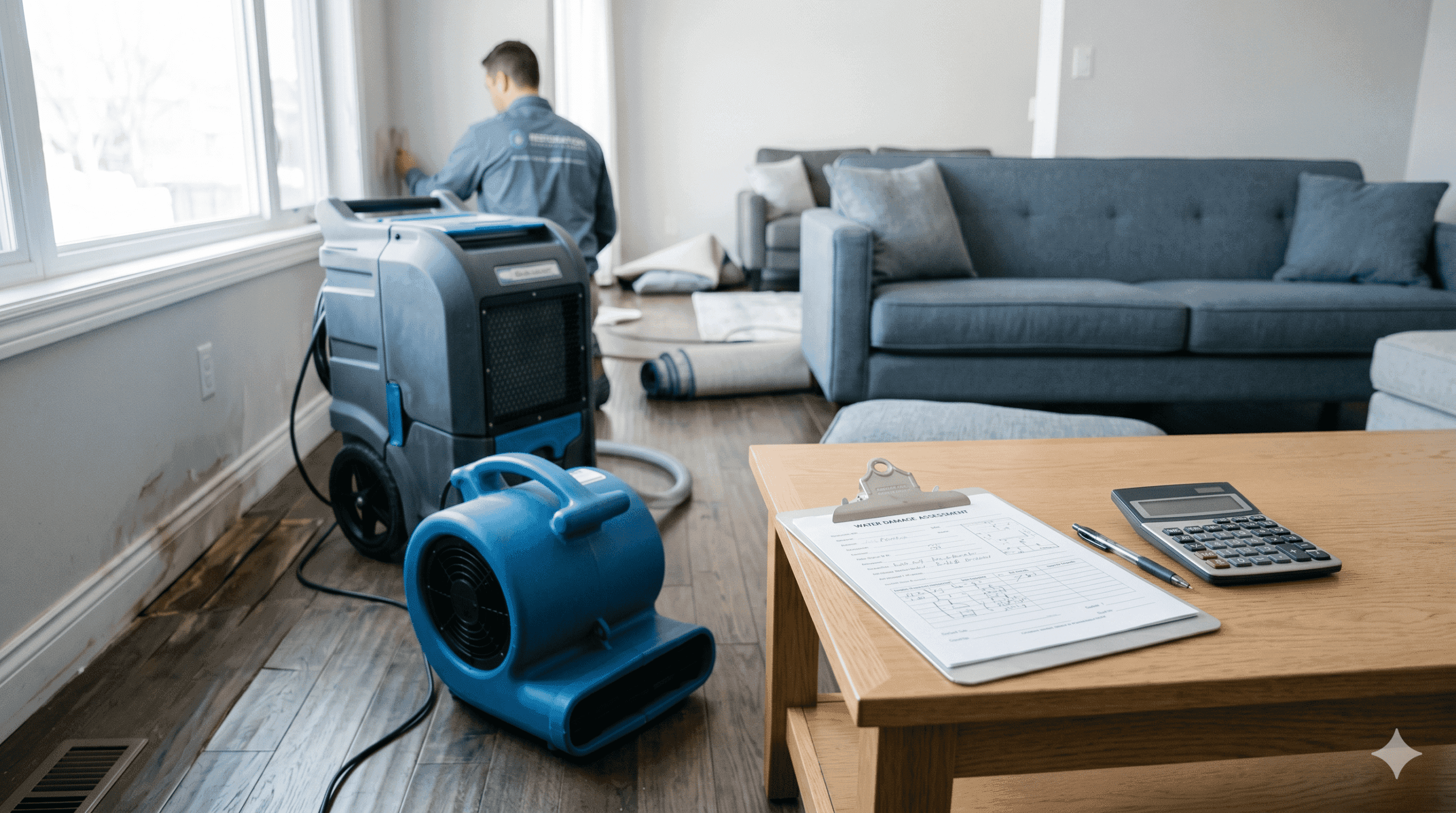
The question comes right after the emergency: how bad is this going to be financially? The honest answer is that water damage restoration costs vary significantly — from under $1,500 for a small, clean water event caught within hours, to $20,000 or more for severe or sewage-related flooding affecting multiple rooms.
Here is a full breakdown of what drives the number, what the typical ranges look like, and how insurance affects your out-of-pocket cost.
Key Takeaways
- Water damage restoration costs range widely — from under $1,500 for a small clean-water event caught within hours to $20,000 or more for severe or sewage-related flooding across multiple rooms.
- Five factors drive the cost: the water category, the square footage affected, which materials were saturated, how quickly treatment began, and whether mold is present.
- Speed is the most controllable factor — a clean-water event treated within two hours often needs only extraction and drying, while the same event after 12–24 hours may require drywall removal.
- These restoration figures cover extraction and structural drying only; reconstruction (replacing drywall, flooring, and trim) is billed separately and adds $2,000 to $15,000 or more.
- Most standard homeowners policies cover sudden, accidental water damage, so your out-of-pocket cost usually comes down to your deductible and whether the cause qualifies.
The Five Factors That Drive Water Damage Restoration Cost
Water Category
The single biggest cost driver is what type of water caused the damage.
Category 1 (clean water from supply lines, water heaters, or appliances) is the least costly to remediate. Surfaces can often be dried in place.
Category 2 (gray water from appliances, washing machines, toilet overflow without solids) requires sanitization in addition to drying. Some porous materials must be removed rather than dried.
Category 3 (black water from sewage backups, floor drain backflows, or external flooding) is the most expensive. All porous materials in contact with the water — carpet padding, drywall, insulation — are typically removed entirely. Sanitization and air scrubbing are required throughout.
(For a full explanation of water categories, see: Water Damage Categories: What Category 1, 2, and 3 Actually Mean.)
Square Footage Affected
Restoration professionals price primarily by the square footage of affected area. A 200-square-foot bathroom with a failed supply line is a fundamentally different job than a 1,500-square-foot basement flooding event, even if both involve the same category of water.
Which Materials Were Saturated
Different building materials absorb and release water differently — and at very different costs to dry or replace:
- Concrete and tile: Dries relatively quickly, can usually be dried in place
- Carpet and carpet padding: Carpet may be salvageable depending on water category; carpet padding is almost always removed and replaced
- Drywall: Can be dried in place if treated within 24–48 hours; otherwise removed
- Hardwood flooring: Can sometimes be dried if treated quickly; may warp or cup if exposure was prolonged
- Structural wood framing, subfloor, and insulation: The most expensive materials to address — insulation is typically removed, structural wood must be dried to specific moisture content levels
How Quickly Treatment Began
Time is arguably the most controllable cost factor. A Category 1 event treated within 2 hours often requires only extraction and standard drying equipment. The same event with 12–24 hours of untreated exposure may require drywall removal once moisture has wicked into wall cavities.
The 48-hour window is important: after approximately 48 hours of sustained high humidity in affected materials, conditions become favorable for mold growth. Once mold is present, the project moves from drying to remediation — a separate and more expensive scope of work.
Mold Presence
If water damage was not treated promptly — or was discovered days or weeks after the event — mold may already be present inside wall cavities, behind flooring, or within the HVAC system. Mold remediation adds $500 to $6,000 or more to total project cost depending on how widely it has spread.
Typical Cost Ranges by Damage Scope
These ranges represent industry averages for professional water extraction and structural drying. They do not include structural reconstruction (drywall replacement, flooring installation, painting) which is a separate scope of work often handled by a general contractor after the restoration phase is complete.
| Damage Scope | Typical Restoration Cost |
|---|---|
| Minor — Category 1, under 50 sq ft, treated within hours | $500 – $1,500 |
| Moderate — Category 1–2, single room, treated within 24 hours | $1,500 – $4,000 |
| Significant — Category 1–2, multiple rooms or subfloor involved | $4,000 – $9,000 |
| Severe — Category 2–3, large area, delayed treatment, or mold present | $9,000 – $20,000 |
| Major — Category 3 throughout multiple floors, structural damage | $20,000 – $50,000+ |
These are restoration costs only. Reconstruction — replacing removed drywall, flooring, insulation, and trim — is billed separately and adds $2,000 to $15,000+ depending on the scope.
Typical Cost by Line Item
If you receive a detailed scope of work from a restoration company, these are the typical ranges for individual line items:
- Water extraction (equipment and labor): $500 – $2,500
- Structural drying equipment deployment (per day, per unit): $100 – $400/day per dehumidifier or air mover
- Complete drying cycle (3–5 days): $1,000 – $4,000
- Antimicrobial treatment: $200 – $1,000
- Mold remediation (if applicable): $500 – $6,000+
- Contents pack-out and storage (furniture, belongings): $500 – $3,000+
How Insurance Affects Your Out-of-Pocket Cost
Most standard homeowners insurance policies cover sudden and accidental water damage — including the full cost of professional extraction and structural drying. What you actually pay out of pocket depends on:
- Your deductible: Typically $500 to $2,500 on most homeowners policies
- Your coverage type: ACV (actual cash value, which deducts depreciation) vs. RCV (replacement cost value, which pays to restore to pre-loss condition)
- Whether the cause qualifies: Sudden pipe failure is covered. Gradual leaks from deferred maintenance are typically excluded.
Professional restoration companies routinely work directly with insurance companies, submitting documentation directly to your adjuster. In most covered claims, you pay your deductible and the insurer handles the balance.
(Related: Does Homeowners Insurance Cover Burst Pipe Water Damage?)
Why Getting a Professional In Fast Reduces Total Cost
Every hour of delayed treatment potentially adds cost. Here’s why:
Water travels through building materials via capillary action — it does not stay where it landed. A burst pipe in a second-floor bathroom will wick downward through subfloor, into first-floor ceiling cavities, and eventually into structural framing over the course of hours. Each material it reaches becomes part of the restoration scope.
A restoration company that arrives within a few hours of the event may dry the structure entirely without removing a single piece of drywall. The same event — treated after the water has fully saturated wall cavities — may require drywall removal, new insulation, and reconstruction.
The restoration cost difference between early and delayed response can easily be $3,000 to $8,000 on a moderate event. The reconstruction cost difference is additional.
Frequently Asked Questions
Should I get multiple quotes for water damage restoration?
For non-emergency, slower-developing damage (a slow leak discovered after the fact), yes — comparing scopes and costs is reasonable. For an active flooding emergency, speed of response typically matters more than cost comparison. Most insurance companies also have preferred vendor networks that handle pricing negotiation directly.
Can I negotiate the price with a restoration company?
The scope is driven by what the moisture readings show — not what either party prefers. A legitimate restoration company will not cut a drying cycle short because of cost preference, as incomplete drying leads to mold and structural deterioration. Where you may have flexibility is in the reconstruction phase.
How is restoration different from reconstruction?
Restoration means stabilizing and drying the structure — stopping active damage. Reconstruction means rebuilding: new drywall, flooring, paint. Restoration companies handle the first phase. Some do both; others hand off to a general contractor. Ask upfront which services are included in the quote.
My restoration company says I need a full wall tearout — do I really?
If moisture readings inside the wall cavity exceed drying thresholds and the wall cannot be adequately dried with equipment alone, tearout is the professionally responsible recommendation. Leaving moisture-saturated drywall in place is the primary driver of mold development. An insurance adjuster should verify the scope recommendation with their own review.