
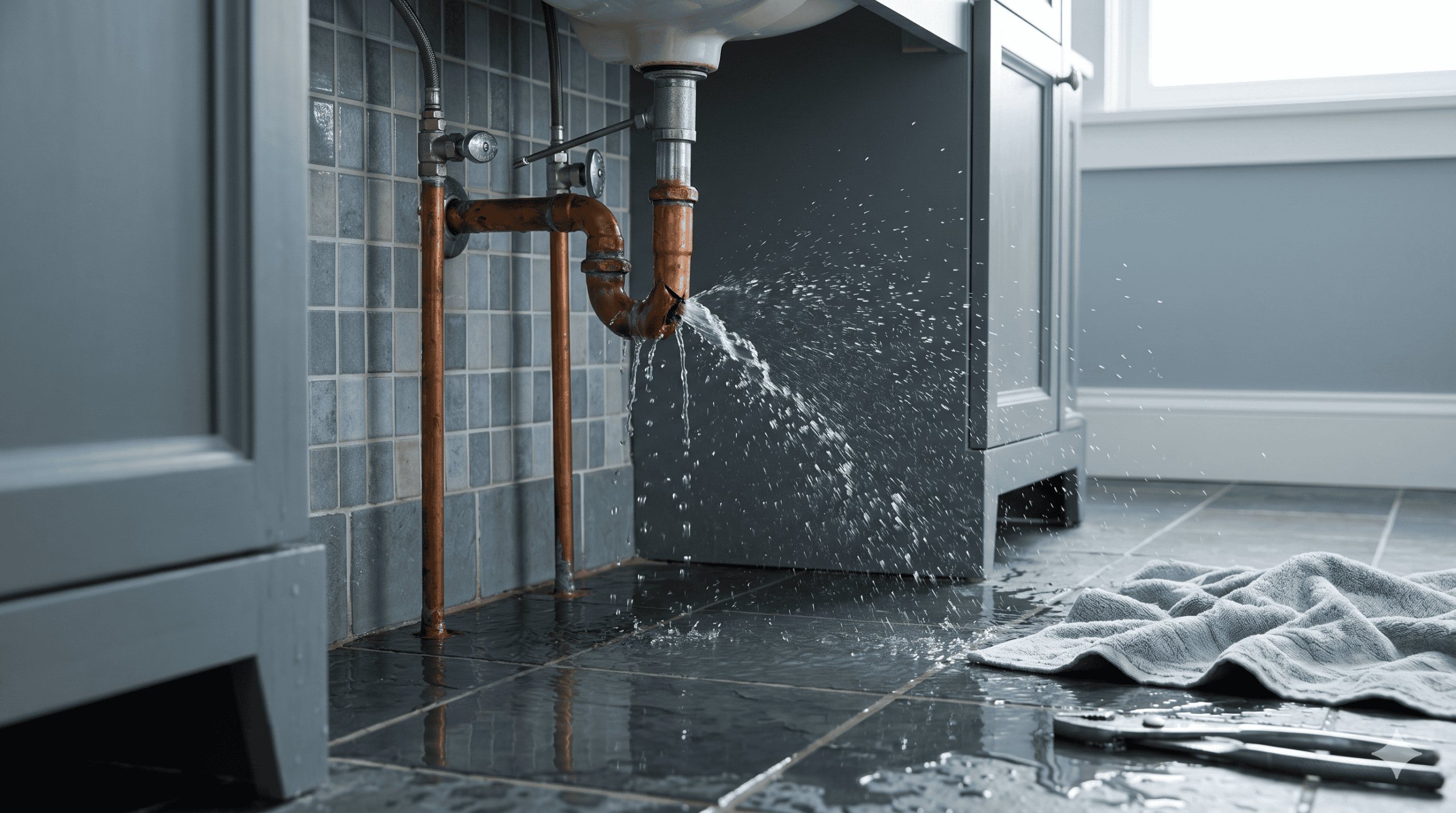
When a pipe bursts inside your home, the damage clock starts immediately. A broken half-inch supply line discharges roughly two gallons of water per minute. A failed main line or copper feed can release significantly more. In thirty minutes, you can be dealing with 60 or more gallons spreading through your walls, subfloor, and structural framing.
What you do in those first minutes directly determines how expensive and extensive the repair becomes. This guide gives you the exact steps, in the right order.
Key Takeaways
- Shut off your main water supply first — a burst half-inch supply line releases about two gallons per minute, so every second counts. Then open a low faucet to drain remaining pressure.
- Cut electricity to any flooded area before entering it; water near live electrical systems is a life-threatening hazard, not just a property one.
- Document everything with video and photos before you move anything or start cleanup — this evidence is what your insurance adjuster uses to verify your claim.
- Avoid DIY drying: a household shop vac and fans pointed at wet walls can’t reach moisture trapped inside drywall and subfloors, and can drive it deeper, creating conditions where mold begins within 48 hours.
- Call a water damage restoration professional in addition to a plumber — the plumber stops the leak, but extracting moisture from building materials is a separate job that decides your total repair cost.
Step 1: Shut Off the Main Water Supply Immediately
Before anything else. Every second the supply is open adds to the damage. Your main shutoff valve is typically located in one of these places:
- In the basement or crawlspace, on the wall closest to the street
- In a utility closet near the water heater or laundry area
- Outside, at a curb stop box near the sidewalk or foundation
Turn the valve clockwise (right) to close it. Once shut off, open a faucet on the lowest floor of your home to drain the remaining water pressure from the lines. This stops additional water from releasing even after the main is closed.
If you don’t know where your shutoff is, find it today — before a pipe ever bursts.
Step 2: Turn Off Electricity to Any Affected Area
If water has reached a room with electrical outlets, appliances, a breaker panel, or any wiring — do not enter it until the power is off. Go to your breaker panel and cut the circuit for every zone that is flooded or at risk of flooding.
If you are unsure which breaker controls the affected area, or if the breaker panel itself is in a wet zone, do not touch it. Call your utility company and ask them to cut power to the building from the street.
Water near live electricity turns a property emergency into a life-threatening one. This step is non-negotiable.
Step 3: Document Everything Before You Touch Anything
Take your phone and record a video walkthrough of every affected room before you move a single item or begin any cleanup. Walk slowly. Capture:
- Where water is actively standing and how high it has risen
- The location of the pipe failure, if visible
- All affected walls, ceilings, and floors
- Any furniture, appliances, or personal property in the water
- Any visible structural damage
After the video, take still photographs from multiple angles as backup. Check that your phone is timestamping the files.
This documentation is what your insurance adjuster uses to verify the scope of damage. Starting cleanup before documenting creates gaps in your claim record that adjusters are trained to challenge. Do not skip this step.
(For a full guide to insurance documentation, see: How to Document Water Damage for an Insurance Claim.)
Step 4: Move Valuables and Protect What You Can
Once you have your documentation, quickly move:
- Electronics, documents, photographs, and irreplaceable items to a dry room or upper floor
- Furniture you can safely lift — even getting the legs off a wet carpet surface (using plastic cups, foil, or wood blocks) reduces absorption significantly
- Area rugs — these trap moisture against hardwood floors and accelerate warping
Do not attempt to move anything that is waterlogged, structurally compromised, or too heavy to safely lift. Do not enter any area where the structural integrity of the floor is uncertain.
Step 5: Do Not Use a Household Shop Vac or Point Fans at Wet Walls
This is where most homeowners make a costly mistake.
A household shop vac removes visible surface water. It cannot extract moisture from inside drywall, behind baseboards, inside insulation, or within subfloor materials. You remove what you can see while the water causing structural damage stays exactly where it is.
Similarly, pointing fans at wet walls — without first performing moisture mapping — often drives moisture deeper into wall cavities rather than drawing it out. This creates stagnant, high-humidity pockets inside your structure where mold can begin developing within 48 hours.
Removing puddles from hard floor surfaces with a towel or wet/dry vac is reasonable. Stop there and leave everything else for professional extraction equipment.
Step 6: Ventilate the Space
Open interior doors and, if outdoor conditions allow, windows to improve air circulation. This will not dry your structure — that requires industrial-grade dehumidifiers — but it reduces the immediate humidity spike in the affected space, which slows the conditions that support mold germination.
If the outdoor air is warmer and more humid than the inside (common in summer months), keep windows closed. The goal is lower relative humidity in the affected space, not airflow for its own sake.
Step 7: Call a Water Damage Restoration Professional — Not Only a Plumber
A plumber stops the leak. That is essential, and you should call one. But stopping the leak is only the beginning of what needs to happen.
Water damage restoration is a separate profession. After the source is contained, a qualified restoration crew brings:
- Truck-mounted extraction equipment that pulls moisture out of building materials, not just off surface floors
- Thermal imaging to locate hidden moisture pockets inside walls and below floors
- Industrial dehumidifiers that dry out enclosed spaces far beyond what household equipment reaches
- Daily moisture monitoring to track humidity, temperature, and drying progress across the whole affected area over several days
- Insurance documentation — detailed moisture readings, drying logs, and scope-of-work records that adjusters require for claim approval
The longer water remains inside building materials, the further it travels and the deeper the structural damage becomes. After 48 hours in humid conditions, dormant mold spores can begin to germinate in affected areas. Speed of professional response directly determines total restoration cost.
(Related: How Much Does Water Damage Restoration Actually Cost?)
Frequently Asked Questions
Does my homeowners insurance cover a burst pipe?
In most cases, yes. Standard homeowners insurance covers sudden and accidental pipe failures, including the resulting water extraction and structural drying. Gradual leaks from long-term neglect are typically excluded. See our full guide: Does Homeowners Insurance Cover Burst Pipe Water Damage?
Can I handle burst pipe cleanup myself?
For a very small, contained spill with no wall or floor penetration, basic surface mopping and drying may be adequate. For anything involving wall cavities, subfloor, insulation, or standing water more than a few inches deep, professional extraction is strongly recommended — not because of liability, but because hidden moisture inside building materials causes compounding structural damage that household equipment cannot address.
How long does professional water damage restoration take?
A standard structural drying cycle takes 3 to 5 days with industrial drying equipment running continuously. The timeline depends on which materials were affected, how long the water was present before treatment began, and the local humidity conditions. Your restoration crew will track daily moisture readings to confirm when drying is complete.
What if the pipe burst overnight and I didn’t discover it until morning?
Call a restoration professional immediately. Overnight exposure does increase damage scope and cost, but prompt professional intervention still significantly reduces the total structural impact compared to waiting further. The 48-hour mold window is measured from initial saturation — if you’re within that window, fast action still matters.